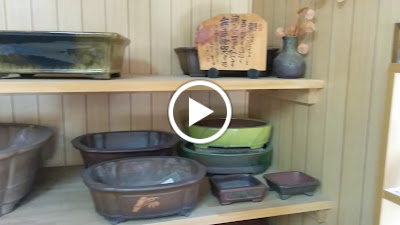
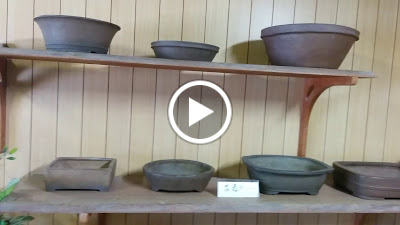
On the last trip to Japan I asked Oyakata is we can go visit Gyozan. Gyozan is the name of the kiln, not the person, per-se. The artist’s name is Yukizyou Nakano, but in the bonsai community he is respectfully known as Gyozan-san. This is coming from my Oyakata, Junichiro Tanaka, and not just my opinion. In my opinion, however, he is one of the three top potters to come out of Japan along Tofukuji and Shyuzan, both are not with us any longer.
I have been “friends” with Gyozan on Facebook for a while, and I suggest that you follow him as well. He does not produce pots full time anymore as he is retired, but he still makes pots for fun and take commissioned work sometimes. Knowing that my oyakata is not likely to bother another professional I decided to ask Gyozan myself, through facebook and sent him a message (using google translate which I ran by Oyakata first) and he responded pretty quickly, but in Japanese. At this point I had to get out of the way and asked Oyakata to call him directly so they arranged a plan to stop by on the way to the airport. Nagoya airport is actually in Tokoname, where Gyozan’s house/kiln is located.
So on my llast morning in Nagoya, Oyakata and Martin, the new apprentice at Aichi-en, and I got into the van with all my luggage, and drove down to Tokoname. What follows is a whole bunch of photos from this visit. I remember thinking that I should not be there, that I am not worthy of this experience, that this is better than a dream come true, but the dream was getting better and better as it went on. We walked in and started by just looking around. Oyakata and Gyozan-san were having a lively conversation while Martin and I were looking around and taking pictures, first downstairs than upstairs. His wife was super nice as well and tried talking to us in English. I was getting more and more euphoric seeing all his pots from different years. I did not even know that he made such a wide gamut of glazed pots. At some point I asked Oyakata to tell Gyozan-san that “now I can die happy” and both of us had tears in our eyes (but I probably just imagined it).
Then we went to see the studio and the kiln. And then Oyakata looked at us and said “now we make pots!” I almost lost it. Can you believe that? I have never made a pot, or even considered the possibility of it. So we did what he showed us and answered questions about how we would want the final pot to be. But there was one problem – it was close to 2.5 hours before my flight and we still had clay all over our hands. So I was starting to get nervous, but then I decided that if I miss my flight home because I was making pots with Gyozan so be it – I am still the lucky one.
With about two hours and 15 minutes before my flight Oyakata finally spoke to me and said “Rusty, I have to leave now because I got a call from my client who needs me to come over right away, so Gyozan is going to take you to the airport.” That’s right. I got a ride to the airport from one of the best potters in the world of all time (IMHO) and his wife. They even insisted on walking me to the terminal while I tried telling them that I can find my way and they have done enough.
So, I don’t know how this happened that I had enough good karma to get so lucky, but this is one of those days that I will remember for a long long time.
PS. I got a message from Gyozan-san asking me where to send the pot. I could not bring myself to ask him to send it to the States so instead Oyakata is going to pick it up for me and send it over.
Search This Blog
Sunday, February 5, 2017
Monday, January 23, 2017
Two trees from Taikan Ten 2016
At the end of the set up day I asked Mr. Tanaka about his favorite trees at the show. And he took me to see two trees I completely missed. This is the story of what he told me.
The first tree is root-over-rock trident maple. It is owned by Mr. Yanai and I remembered him from Bjorn’s video about Bunjin-gi trees. Oyakata explained that this is an old tree, maybe even 100 years old, and 100 years ago someone threaded the roots through the stone and grew this tree slowly. It is not a strong “in your face” tree, but it has a great feeling and great history as a bonsai.
Speaking of bonsai history – the second tree that Oyakata took me to look at was a 500 year old white pine grafted onto a black pine trunk. And he said that it was grafted 500 years ago. So around the same time that Columbus was “discovering” America a dude in Japan was grafting white pine branches onto a black pine trunk. That just blew my mind!
And to finish off with another great tree, although it was not in the show, here is a picture of a tree the John Milton wired and oyakata "made look nice" for a client. This tree is about 4 feet toll (those are two b fours under it).
There are a ton of pictures I took at the show, but I am not sure if I should write about all those, or just post a link to the album - suggestions are welcome. One thing is for sure - I will be writing my next post about the visit to Gyozan!
Friday, December 23, 2016
Two movies from Taikan-ten
I have never been to a bonsai show in Japan. In fact, I have never been to a bonsai show other than the our local club show. So when I found out that this year Taikan-ten is going to be during the week of Thanksgiving I figured I should go. Negotiations with family did not take long either – being married to a saintly woman does help. And, by a happy coincidence I bought tickets that got me to Aichi-en (the nursery I visit once a year) the night before setup. I landed in Nagoya around 9PM and we left the next morning around 5:30AM. What jetlag?
Taikan-ten is arguably the second best show in Japan, after Kokufu-ten, which takes place in Tokyo around February (would be harder for me to attend because of teaching). Also, Kokufu is much more crowded and overwhelming. Both Janet Roth and Mas Nakajima of https://suisekiart.com/ said that I should consider going to Taikan-ten because it is much easier to enjoy and it take place during a much better time of the year than Kokufu, and I would always prefer Kyoto to Tokyo.
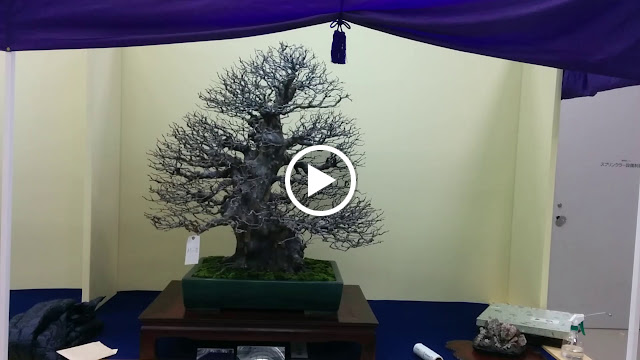
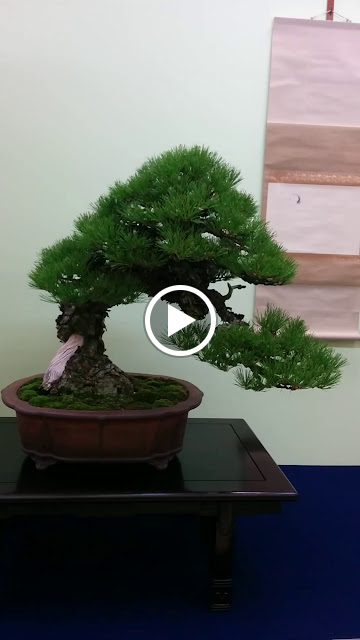
There are too many things to share in one blog so I think I will break it into a number of posts and I will start with two movies that I took at the show (and this is not to compete with Bjorn).
The first one is of the four winning trees from the last Kokufu. I stopped talking in the middle of it for two reasons: First, I forgot the name of the crab apple and, second, I almost collided with a masked man who was very interested in those trees as well. To watch the movie click here.
.
The second movie is of one of my favorite trees at the show. It is a medium size tree and I overlooked it a couple of times I walked by it, but John Milton, one of the apprentices at Aichi-en drew my attention to it and I then I realized how amazing it is. I think I am really drawn to the understated beauty of this tree. To watch the movie click here.
After I fell in love with this tree I took a number of people to see it - here is Uchi taking a good look.
I will be writing other posts from Taikan-ten in the next few days so keep checking back. There are only 193 pictures in that folder :).
Monday, December 19, 2016
The stories in the needles
I asked Mr. Tanaka once about what part of his apprenticeship he disliked the most and he said “pulling needles”. Then he explained that at Daiju-en, where he was an apprentice they pulled needles for about 3-4 months in a year. Daiju-en is known for its pines, including the candle cutting technique and the discovery of Zuisho pine, both discovered by the farther of the current owner of Daiju-en.
When I started working with pines pulling needles was definitely not my preferred part of the maintenance process. But over the last few years I started enjoying it more and more. I find it to be one of those experiences that really gets you to know your tree, year after year. I try to pull needles a few times a year, depending on how much I get done at different times of the year. Starting in the spring, when the candles start growing I balance the candles and pull down to about 5 pairs of needles on black and red pines (fewer in stronger areas and leave more in weaker areas). If the tree was not decandled last summer this process would have been done in the fall. Then in the summer (June or early July here) I cut candles on strong trees or balance the needles on weaker trees that are not being decandled. And in the fall I select shoots on the trees that were decandled down to two candles (or one in congested areas), pull last year needles and thin out new needles in stronger areas, or pull down to 5 pairs (more or less depending on the strength of the buds) on trees that were not decandled.
One of the things that I noticed is that needle pulling process comes with many special sensations. First thing I noticed is how mentally tiring it is. Looking through the needles for a few hours makes me feel almost dazed and I usually sleep very well after it. The reason for this tiredness is that you have to continuously refocus at different depths - first thing you see are the tips of needles, but then you need to focus on the base of the needles and count them, and often, you doing all the while looking through layers of needles.
There are different techniques people use to pull needles - you can pull with your fingers, you can pull with tweezers, or some just cut them off with scissors. I was shown the "proper" technique of holding scissors in your left hand and moving needles out of the way with scissors while pulling with tweezers in your right hand. I have to admit, I struggle with the "proper" technique, and find the it is easier for me to hold the shoot with my left hand while pulling with tweezers in my right hand.
Puling needles is one of those jobs that really gets you to know your bonsai. Maybe even more than wiring. I often find myself having a conversation with my past self – I often find messages that I left 6 or 12 months earlier. Like when I find a candle with a whole bunch of old needles I wonder “why did I leave so many needles? Did I just miss it?” More likely it is because it was a weak bud and I decided not to cut it during summer. Or maybe I maybe I decided not to pull needles around it the fall before. So now I can see whether it worked or not – if it did the bud will look strong and now I can pull the needles around and decandle in the summer (if all goes well).
Another interesting sensation of pulling needles is the smell surrounding the process. The first smell is the smell of the pine sap - the tree will start bleeding a little as you work and you will get a good introduction to difference aromas of pines. my favorite is red pine, followed by black pine. my least favorite is Zuisho - I get nausiated from the smell of Zuisho sap, so much so that I have considered selling the only Zuisho i have. Depending on how recently you sprayed your trees you might even get a good whiff of pesticides that you used. And the last smell that is the part of the needle pulling process is the smell of burning sap - after a few hours of pulling needles your tweezers will get gunked up with sap and the easiest way to clean them is to burn the sap and then brush it off with a copper brush.
in the late fall/winter I reduce the number of shoots that grew from the spot where the old candle was cut in the summer. There a number of decisions that need to be made at this point. Normally we would try to leave two shoots. The reason not to leave more shoots is to avoid the swelling at the point where the shoots emerge. And that is true not only for pines. But the question is which two. And the answer varies depending on where this candle is in the tree. Often I will try to leave two shoots that are not at 180 degrees to each other. If the shoots are at the top of the tree I might leave two weaker shoots and cut the stronger ones, but at the bottom of the tree or inside i might eliminate the weaker shoots. The goal is always to balance the tree.
The one useful thing to keep in mind is that strong areas will get stronger and weak areas will get weaker, and eventually die. This was explained to me by Peter Tea (more than once and using very short words) and I find that it is one of the fundamental principals to keep in mind. So if you are trying to make weak areas stronger the way to achieve it is to make strong areas weaker, while maintaining the overall health of the tree.
Taking care of the strong areas on the pine is one of the most important things to do to maintain the overall health of the tree so that the weak areas don't get neglected and die off.
Another sensation I notice when pulling needles is that I often get a back pain from bending my back too much. My work table is an engine lift I got from Harbor Freight tools so I can lift the tree or lower it very easily. But I have to remember to do it. What often happens is that I forget to adjust the height of the table in time and end up bending to work on lower branches - not the best strategy. So what I do when I am more conscious is to work horizontally at one level by rotating the tree and then elevating the table to work on lower branches. I pull needles from top to bottom so that i don't drop needles on the areas I already pulled.
The thing that is super important is to not just think about what to do but just do the work. It is important not to be judgmental about the work that you have done last year or doing right now. It is much more important to do the work and make a few mistakes, then not do the work. I often make a list and realize that there is just too much to do, but it is important to do at least what you can. So the important thing is to pick a tree, take it away from the bench that it is on to the working area and work on that tree. You might not be able to get to all your trees, but it is ok. You can do more next time. I often start working on the tree that is not my best tree to get the muscle memory back and the stories in my head straight and then when you feel better about what you are doing work on the better tree. A lot of bonsai is repetitive work so getting in the grove is important.
Subscribe to:
Posts (Atom)